
2025.11.28: Today, SpacePNT has completed the extensive qualification testing of its second generation product, including vibrations, shocks, thermal vacuum and EMC.
This second generation multi-frequency multi-GNSS receiver product is the result of two important ESA ARTES Competitive & Growth (C&G) development projects that have received support from the European Space Agency (ESA) and the Swiss Space Office (SSO).
The first ARTES C&G project has allowed SpacePNT to develop an industrialized second generation product suitable to be produced in larger quantities, i.e., targeting LEO/LEO-PNT/GEO telecom constellations, and embedding amongst other options a proprietary Precise Orbit Determination (POD) algorithm capable to provide sub-decimetre (3D rms) real-time positioning and timing onboard the spacecraft. The POD algorithm has been fully validated in a hardware-in-the-loop environment and already retrofitted into two first-generation flight models already delivered to a customer for integration on the satellite.
Within the second ARTES C&G project, SpacePNT has developed a specific Radiation Hardiness Assurance (RHA) approach that can be proposed as an option for very long duration missions operating in harsh radiation environments. The first mission to benefit from this RHA will be the ESA GENESIS satellite mission that will operate in a difficult MEO environment and for which SpacePNT will supply the critical GNSS receiver equipment.
While this second generation GNSS receiver product is mostly based on the same HW/SW/FW technology as already integrated into SpacePNT’s first generation receiver product with flight heritage, it was still necessary to perform a complete qualification campaign that included vibration tests, shock tests, thermal vacuum cycling, and finally EMC tests in order to validate the changes.
Dr Cyril Botteron, CEO and co-founder: “I am very proud of the entire SpacePNT Team for their incredible work in preparing and executing all of the radiation and qualification tests in just 12 months.”
Having passed successfully all of the qualification and performance tests, SpacePNT can now start manufacturing the first flight models of its second generation products that have already been ordered by several customers to fly in various demanding Earth observation, in-orbit servicing and space exploration missions ranging from LEO, MEO, GTO/GEO, and even Moon altitudes.
Disclaimer: “The view expressed herein can in no way be taken to reflect the official opinion of the European Space Agency.”
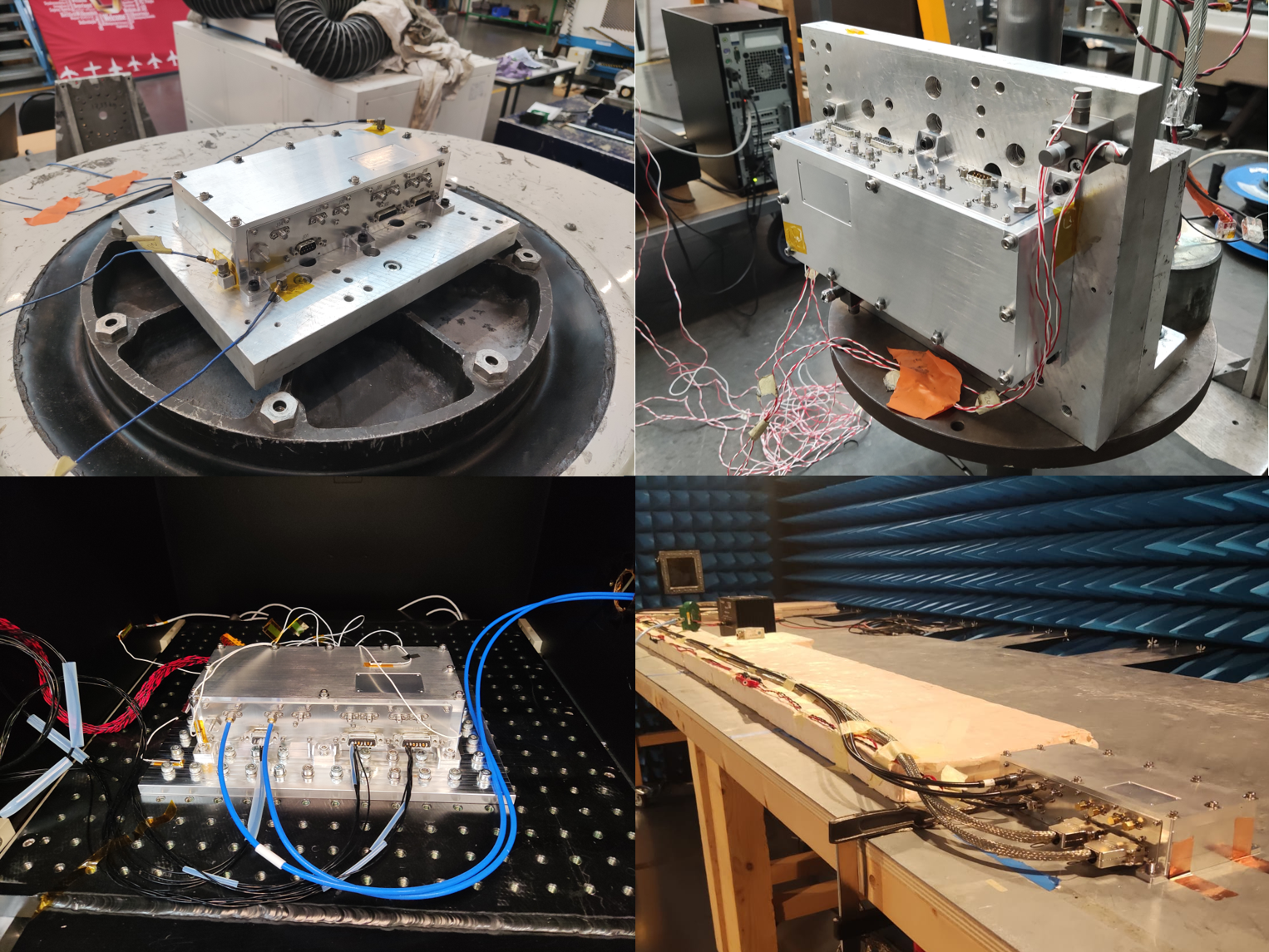
From top left to bottom right: vibrations, shocks, thermal vacuum, and EMC qualification testing (Photo credit: ©SpacePNT)